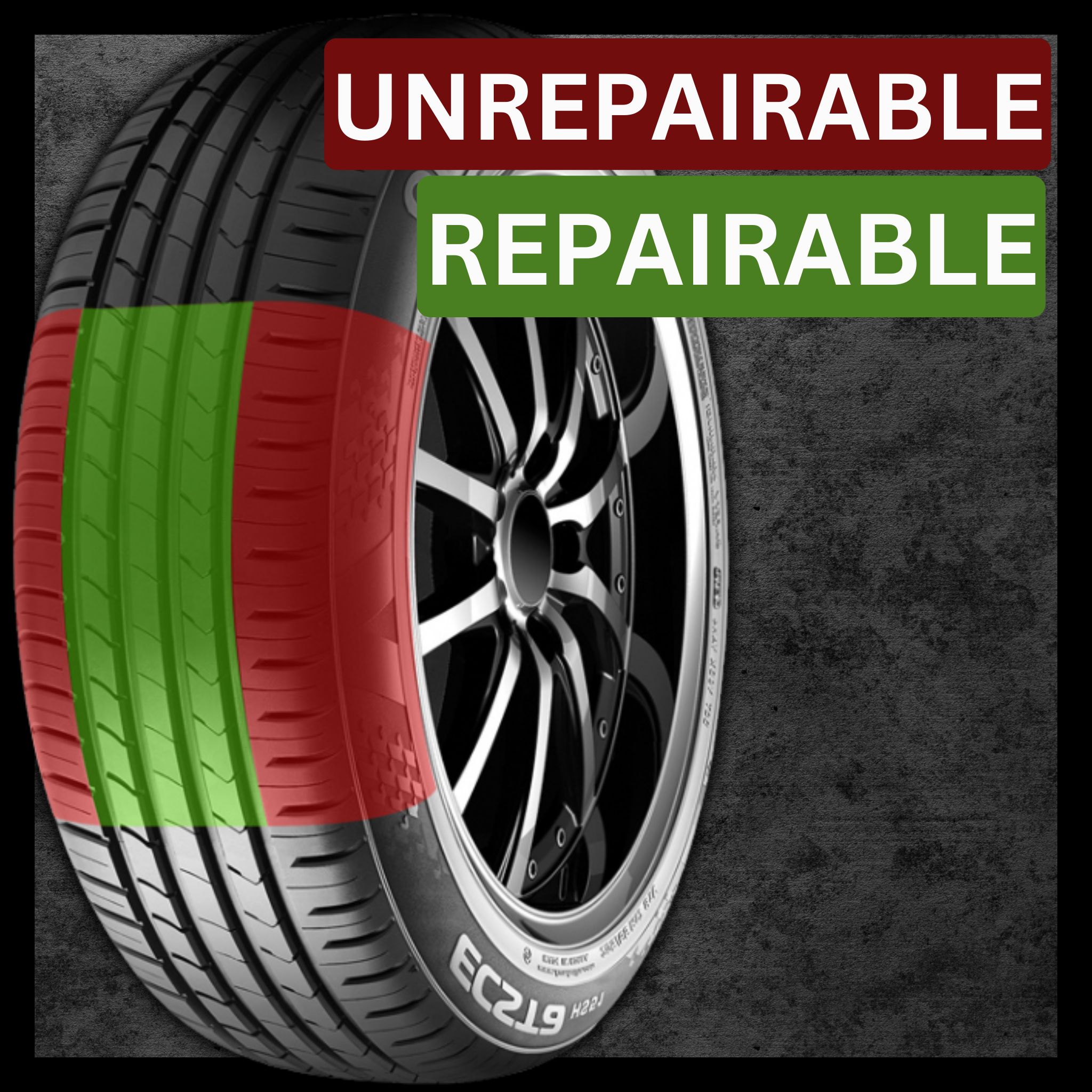
One of the most common questions we get on a service call is simple: "Can you just patch it?" Sometimes the answer is yes. Sometimes it isn't — and driving on an improperly repaired tire is a real safety risk, not just an inconvenience.
The general rule for a safe repair
A puncture can usually be repaired when it's a clean hole up to about 1/4 inch (6mm) across, located in the tread area, away from the sidewall, and the tire hasn't been driven on while flat. When those conditions are met, we use an industry-standard patch-plug combination that restores a safe, lasting seal.
When we recommend replacement instead
Not every puncture meets that bar. As a general guide:
- A nail or puncture near the sidewall — the sidewall flexes every time the tire rotates, so a repair there is much more likely to fail, even if it seals initially.
- A rip or tear — a clean, round puncture seals differently than torn rubber. Rips and tears leave damage a patch can't reliably seal.
- A blowout — once a tire has failed structurally, there is no repair that restores it to a safe condition. It needs to be replaced.
Multiple punctures, a tire that's been driven flat, or tread depth that's already near the legal minimum will usually push us toward replacement as well.
What this means for your service call
We carry a wide selection of common tire sizes on our vans, so in many cases we can replace a non-repairable tire during the same visit. If we're called out and the tire turns out not to be repairable, a $60 call-out fee applies for that visit — but if you book us to come back within 48 hours to install a replacement, we rebate $30 of that fee.
See our full flat tire repair page for more detail, or book an appointment and we'll assess your tire on site.